Thailand Data Plans: Compare Cost per GB, Speed, and Coverage
A Thailand data plan priced at only a few dollars looks like an easy win. But the cheapest option can cost more once small data limits, throttling, weak routing, or setup delays get in your way.
The 2025 TrueMove H tourist SIM price is only useful when you compare what you actually get. Check the total high-speed data, cost per gigabyte, network access, validity, and activation process before choosing a plan. A low sticker price means little if your connection drops after 500MB, your video call lags, or you spend your first hour in an airport queue.
Tourists need reliable maps and rides, business travelers need stable calls, families burn through data quickly, and digital nomads can’t afford constant interruptions. Use this Thailand eSIM cost per GB guide as a starting point, then compare each plan by real value, not clever pricing.
Thailand Data Plans: When Cheapest Is Not Best
A cheap Thailand data plan only looks like a bargain until you check the details. Compare four points: usable high-speed data, real cost per gigabyte, network access, and activation time.
Compare real value instead of the headline price
The advertised price is only the starting point. A plan with strict daily limits may leave you with slow data after a small allowance, while a slightly more expensive fixed-data eSIM can keep full speed for the entire package.
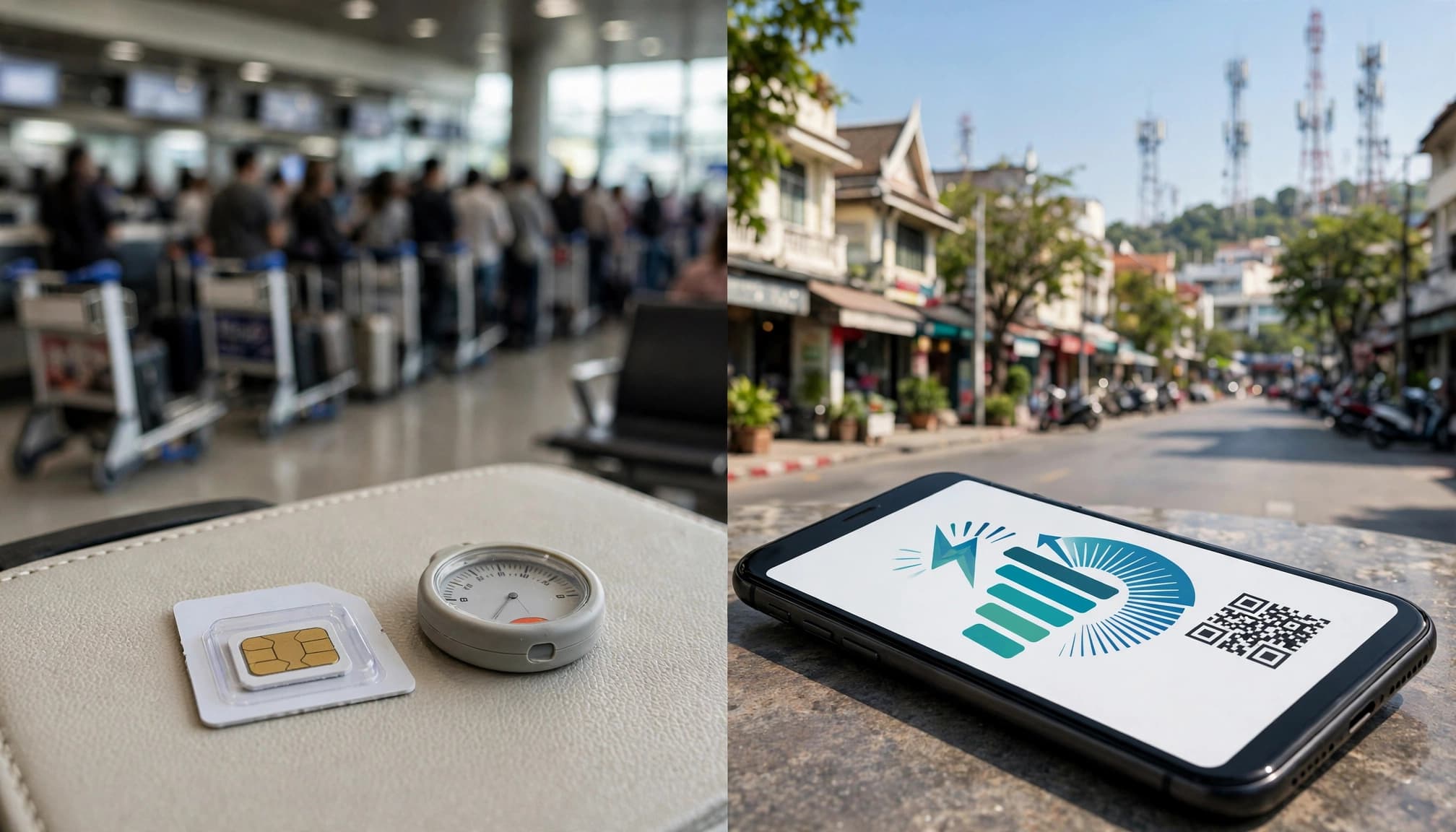
Use this quick comparison before you buy:
| Evaluation metric | Ultra-cheap tourist offers | Reliable direct-network plans |
|---|---|---|
| Real unit cost | Often about $3 to $5 per usable GB | Often about $0.80 to $1.50 per GB |
| Speed rules | May throttle after a small daily limit | Usually provides a clear fixed high-speed allowance |
| Host network quality | May rely on secondary roaming routes | Can connect directly to national carrier infrastructure |
| Setup convenience | May require an airport counter or manual activation | QR installation can happen before departure |
These figures are examples, not universal prices. Packages, exchange rates, promotions, and validity periods change, so calculate the cost from the current terms.
Direct access to national carrier infrastructure can also reduce routing delays. That matters when you load maps, join a video call, or request a ride in a crowded area.
Why the TrueMove H tourist SIM 2025 price needs context
Searches for the TrueMove H tourist SIM 2025 price often compare one number too quickly. A physical tourist SIM and an eSIM may include different data amounts, validity periods, speed rules, taxes, and activation steps.
Check these details side by side:
- How much high-speed data does the package include?
- What happens after you reach the daily or total limit?
- Does the plan access a strong Thai network directly?
- Can you activate it before landing?
- Does the listed price include taxes and registration?
Older 2025 prices may no longer match current package terms. Verify the live offer before paying, then use this travel eSIM setup guide if you want to activate your plan before visiting Thailand.
Four Hidden Costs Behind Ultra-Cheap Thailand Data Offers
Ultra-cheap Thailand data plans often look impressive until you check the service behind the headline price. A plan can cost less upfront but deliver less usable data, slower speeds, weaker routing, or a frustrating airport setup.
Before you compare the TrueMove H tourist SIM 2025 price with another offer, check these four costs. They can affect your trip more than the amount shown at checkout.
The daily fair usage policy speed trap
Many plans use the word “unlimited” while offering only a small daily high-speed allowance. You might receive 500MB at full speed, then face a severe slowdown once you reach that limit.
That slower connection may still technically work, but basic travel tasks become painful. Google Maps can take longer to load, ride-hailing apps may struggle to refresh, and translation tools can stall when you need them most. Photo uploads may fail, while video calls become unstable or impossible.
Picture this: you spend the afternoon visiting temples, upload a few short videos, and use navigation throughout the day. By dinner, your unlimited plan has reached its high-speed limit. Now you cannot quickly request a ride or send your location to a friend.
Before buying, check three details:
- How much high-speed data resets each day?
- What time does the allowance reset?
- What speed remains after you reach the cap?
A fixed package often makes more sense when you need dependable performance. A 10GB or 15GB unthrottled plan gives you a clear pool of high-speed data, rather than a tiny daily allowance with a large “unlimited” label.
You can also calculate your Thailand eSIM data needs before choosing between a fixed plan and a daily unlimited offer.
“Unlimited” describes the data period, not always the connection speed. Read the fair usage policy before trusting the headline.
The high unit price per gigabyte
A low total price does not always mean a good deal. The simple way to check value is to divide the package price by its total high-speed data.
For example, a $4 plan with 1GB costs $4 per gigabyte. A $12 plan with 15GB costs $0.80 per gigabyte. The second plan costs more at checkout, but it gives you far more usable data for each dollar.
That difference matters on a longer trip. A tourist who uses maps, social media, translation apps, and ride-hailing services can finish 1GB quickly. Buying several tiny packages may cost more than choosing one larger package from the start.
Check whether the advertised allowance includes full-speed data. Some offers combine a small high-speed amount with slower unlimited access. Others advertise a large total number but apply separate daily limits.
Expiry rules matter too. A package may look affordable until unused data disappears after a short validity period. You should compare:
- Total price and total high-speed data.
- Cost per usable gigabyte.
- Validity period.
- Any daily speed cap.
- The treatment of unused data.
A cheap plan makes sense only when it gives you enough fast data for your trip. If not, the low sticker price simply hides a high unit cost.
Secondary network routing can slow everyday tasks
Not every low-cost travel plan connects to a Thai carrier in the same way. Some resellers use roaming arrangements or indirect routing instead of direct access to a primary local network.
That does not make every reseller unreliable. The important point is that routing can affect performance, especially when your data travels through additional network links before reaching its destination.
Higher latency creates delay rather than simply reducing signal strength. A webpage may take longer to begin loading, cloud apps can feel sluggish, and voice calls may develop awkward pauses. Video meetings need a stable connection, while online payments may time out if the network response takes too long.
Imagine trying to pay for dinner through a banking app while standing outside a busy restaurant. Your phone shows strong signal bars, but the payment screen keeps spinning. Signal strength alone does not tell you how quickly data travels.
Check the plan’s named host network before you buy. Look for the local carrier, expected coverage, and whether the service uses direct network access or roaming. You should also consider where you are traveling, since coverage in Bangkok may differ from coverage on islands or in rural areas.
The buying rule is simple: choose a plan that clearly identifies its Thai network partner and access method. Vague descriptions leave you guessing about the connection you will actually receive.
Airport queues can cost more than the savings
A physical SIM from an airport counter can look like the cheapest option. Yet the price difference may disappear once you account for the time and effort required after landing.
Busy arrival halls can bring long queues, passport checks, device setup, and language barriers. Staff may need to confirm your phone details, register the SIM, and explain the package terms. After a long flight, waiting for basic internet can feel like paying with your first hour in Thailand.
You may need maps immediately. You might also need a ride, a hotel address, or a translation tool before you leave the airport. Without mobile data, finding the right pickup area becomes harder.
An eSIM lets you complete most of the setup before departure. Download the profile on stable home Wi-Fi, then follow the provider’s instructions about when to activate mobile data. Some plans begin as soon as you install them, while others start when the eSIM connects to a supported network.
Check that your phone supports eSIMs and has no carrier restrictions. Keep your primary SIM available if you need banking codes or travel messages.
The buying rule is clear: install and test the eSIM profile before your flight, but activate the travel line at the correct time. Saving a dollar is not worth starting your trip without maps, rides, or a working connection.
How much data do you need for a Thailand trip?
Trip length gives you a starting point, but your habits decide the final number. Maps and messages use little data, while video streaming, photo uploads, hotspot use, and video calls can drain a plan quickly.

Use these ranges as practical starting points, not strict rules:
| Trip length | Suggested data range | Typical activities |
|---|---|---|
| 1 to 7 days | 5GB to 8GB | Maps, translation, rides, messaging, light browsing, occasional posts |
| 8 to 15 days | 10GB to 15GB | Navigation, social media, photos, VoIP calls, bookings, restaurant searches |
| 16 to 30 days | 20GB to 50GB | Heavy navigation, remote work, video calls, cloud backups, hotspot use |
Short breaks from one to seven days
Plan on 5GB to 8GB for a short Thailand visit. That range covers Google Maps, translation tools, ride-hailing, messaging, light browsing, and occasional social posts.
A smaller 2GB or 3GB plan may work if you use hotel Wi-Fi and avoid uploads. Choose more data if you share photos often, stream music throughout the day, or connect another device.
Download offline maps before departure. You can still use saved routes when your signal drops, and offline areas reduce repeated map downloads during the trip. Travelers comparing regional options can also review these Asia travel eSIM data plans for broader coverage.
Standard vacations from eight to fifteen days
Most tourists should choose 10GB to 15GB for an eight-to-fifteen-day trip. You get room for regular navigation, social media, photo uploads, VoIP calls, restaurant searches, and travel bookings.
This range gives you a useful buffer without paying for excessive data. Still, video streaming changes the calculation fast. Frequent hotspot use, long video calls, and automatic photo backups can push a 15GB plan toward its limit.
Extended stays from sixteen to thirty days
Choose 20GB to 50GB, or consider a renewable monthly package, for a longer stay. Remote workers and students may need the higher end for cloud backups, online classes, video calls, and hotspot connections.
Before buying, check the renewal terms, rollover rules, and monthly speed limits. A large allowance means less when the provider throttles speed halfway through the billing period.
Choose a Thailand eSIM by network quality and total value
The cheapest Thailand data plan can disappoint if it offers weak coverage, tiny high-speed limits, or difficult activation. Compare the network, usable data, device support, and service terms before you compare the price.
Check the network, speed policy, and hotspot rules
Start by identifying the host Thai network. A plan should clearly name its carrier partner, coverage areas, and access method. Check coverage for Bangkok, Chiang Mai, Phuket, popular islands, and rural routes.
Urban coverage may look excellent while remote beaches or mountain roads perform differently. If you plan to visit several regions, choose a provider with clear national coverage claims.
A 5G label doesn’t guarantee constant 5G service. Your phone still needs compatible bands, and local congestion can reduce performance. Buildings, weather, terrain, and network traffic also affect your connection.
Read the fair usage policy before trusting words like “unlimited.” Compare the amount of usable high-speed data, then check what happens after you reach the limit. A fixed 10GB or 15GB allowance may offer better value than unlimited data throttled after 500MB.
Hotspot support matters too. Confirm that tethering works before connecting a laptop, tablet, or travel companion’s phone. Some plans restrict hotspot use, cap it separately, or block it completely.
Confirm device compatibility before ordering
Run this pre-trip checklist before paying for a Thailand eSIM:
- Confirm that your phone supports eSIM technology.
- Check settings for “No SIM restrictions” or an equivalent unlocked status.
- Update your operating system before installation.
- Confirm that your phone has a free eSIM slot.
- Check whether the plan offers data only or includes a local phone number.
- Review customer support and refund rules before checkout.
A data-only plan usually supports maps, messaging apps, browsing, rides, and calls through internet services. A plan with a Thai number may support regular calls or texts, but it can cost more or require extra registration.
You can check eSIM compatibility with an EID before ordering. Keep your primary SIM available for banking security texts and account recovery codes.
Label your home line clearly, such as “Home,” and your travel line as “Thailand Data.” Set the travel line as mobile data, then disable data switching on your home line. Otherwise, your phone may quietly use your primary SIM and trigger roaming charges.
Install the profile before flying, then activate it at the right time
Downloading an eSIM profile and starting its validity period are not always the same action. Some plans begin when you install the profile. Others start when the eSIM connects to a supported Thai network.

Scan the QR code on stable home Wi-Fi before your flight. Check that the travel profile appears in your phone settings, but follow the provider’s instructions before turning it on.
When required, enable data roaming for the travel line only. Keep data roaming disabled on your home line, and turn off automatic data switching. These Thailand travel eSIM APN settings can help if mobile data fails.
If you have no signal, restart your phone and check network selection. If the APN looks wrong, enter the provider’s exact settings. If activation fails, verify the QR code, confirm Wi-Fi access, and contact support before deleting the profile. A deleted eSIM may require a new activation code.
A Simple Pre-Trip Checklist for Reliable Mobile Data in Thailand
A few minutes of preparation can prevent expensive roaming, airport delays, and a dead phone after landing. Follow this checklist before you compare the TrueMove H tourist SIM 2025 price with other Thailand data plans.

Complete these steps before departure
- Check your phone’s lock status. Open your settings and confirm it shows “No SIM restrictions.” An unlocked phone can use a Thailand eSIM instead of forcing expensive roaming.
- Choose by high-speed data and unit cost. Divide the price by the full-speed allowance. This prevents a cheap plan from costing $4 per usable gigabyte.
- Download the eSIM on home Wi-Fi. Install the profile before flying, but activate it according to the provider’s instructions. Stable Wi-Fi prevents airport setup problems.
- Save the provider’s support details. Keep the email, QR code, APN instructions, and support contact offline. You can then fix connection issues without searching for Wi-Fi.
- Keep your primary SIM active for OTP messages. Your home line may still receive banking codes and account security texts. Disable data roaming on that line to avoid surprise charges.
- Download offline maps before leaving. Save your hotel area, airport route, and planned destinations. Offline maps can guide you when activation fails or coverage drops.
- Test the travel line after landing. Turn on the eSIM, select it for mobile data, and open a webpage. If it fails, troubleshoot an eSIM that is not working abroad before leaving the airport.
For official package details, review True’s Thailand tourist SIM options before purchase.
Invest in reliable data for a smoother Thailand journey
Reliable mobile data is part of your travel budget, not an optional extra. The cheapest Thailand data plan often costs more through slow speeds, wasted time, frustration, or emergency top-ups.

Compare the details that affect your trip
The TrueMove H tourist SIM 2025 price gives you a starting point, not the full answer. Look at the plan’s cost per gigabyte, full-speed allowance, network access, validity, and setup process.
A slightly higher price can deliver much better value when it provides more usable data and fewer speed restrictions. Direct network access also helps maps, ride apps, payments, and calls respond when you need them.
The best Thailand data plan is the one that keeps working when your trip gets busy.
Check the activation instructions before departure. Install your profile on stable home Wi-Fi, then activate it at the correct time. If mobile data fails after landing, use this guide to fix an eSIM with no service.
Choose dependable data before you fly
Don’t wait until you reach the airport to solve connectivity problems. Review the plan terms, confirm your phone supports eSIM, and keep your primary SIM available for security codes.
Ready to skip throttling traps? Evaluate the real technical value, then install your travel eSIM for Thailand before departure. That small step can save money, time, and a frustrating first hour after landing.
Conclusion
The lowest advertised Thailand data plan price doesn’t always deliver the best value. Judge each option by reliable high-speed access and total value, not the sticker price or the TrueMove H tourist SIM 2025 price alone.
Before you choose, check the cost per gigabyte, speed limits, direct network quality, and easy setup. A dependable connection supports navigation, bookings, payments, communication, and peace of mind throughout your trip.